
MunicipalActivated Sludge Process (Conventional / A²O / Multi-stage AO / Deep Shaft / Pure Oxygen / Biological Doubling)
Changzhou Jiangbian WWTP Phase V Expansion (200,000 m³/d added; 700,000 m³/d total)
Project Info
- Treatment Capacity
- 700,000 m³/d (whole plant, Phase V adds 200,000 m³/d)
- Location
- China Jiangsu Changzhou Jiangbian Wastewater Treatment Plant by the Yangtze River, Xinbei District
About
Changzhou Jiangbian Wastewater Treatment Plant sits on the bank of the Yangtze in Xinbei District, Changzhou, Jiangsu, at the upstream gate of the Taihu Lake basin. In September 2026 the Phase V expansion, built by China Construction First Building Group, passed completion acceptance, lifting plant capacity to 700,000 m3/d - of which Phase V contributes 200,000 m3/d - making it the largest single municipal wastewater treatment plant in Jiangsu.
Scope and background
Changzhou is the first checkpoint for Taihu water quality. With capacity in the core urban area nearing saturation, Phase V was launched as a combined package: new capacity, retrofit of the existing plant, ecological buffers and water reuse. The works comprised 25 new structures and 26 retrofitted ones, with old and new sections built in parallel - a retrofit the contractor describes as one of the hardest of its kind in China.
Process
Phase V applies modified AAO biological treatment, followed by solids separation, deep-bed filtration and ozone disinfection; effluent key indicators meet Surface Water Class IV. A UF+RO membrane workshop produces reclaimed water for cooling, industrial reuse, district heating and cooling, and ecological replenishment. Sludge is anaerobically digested and dewatered; the biogas is upgraded to methane and used for power generation, complementing rooftop PV and water-source heat pumps.
Performance
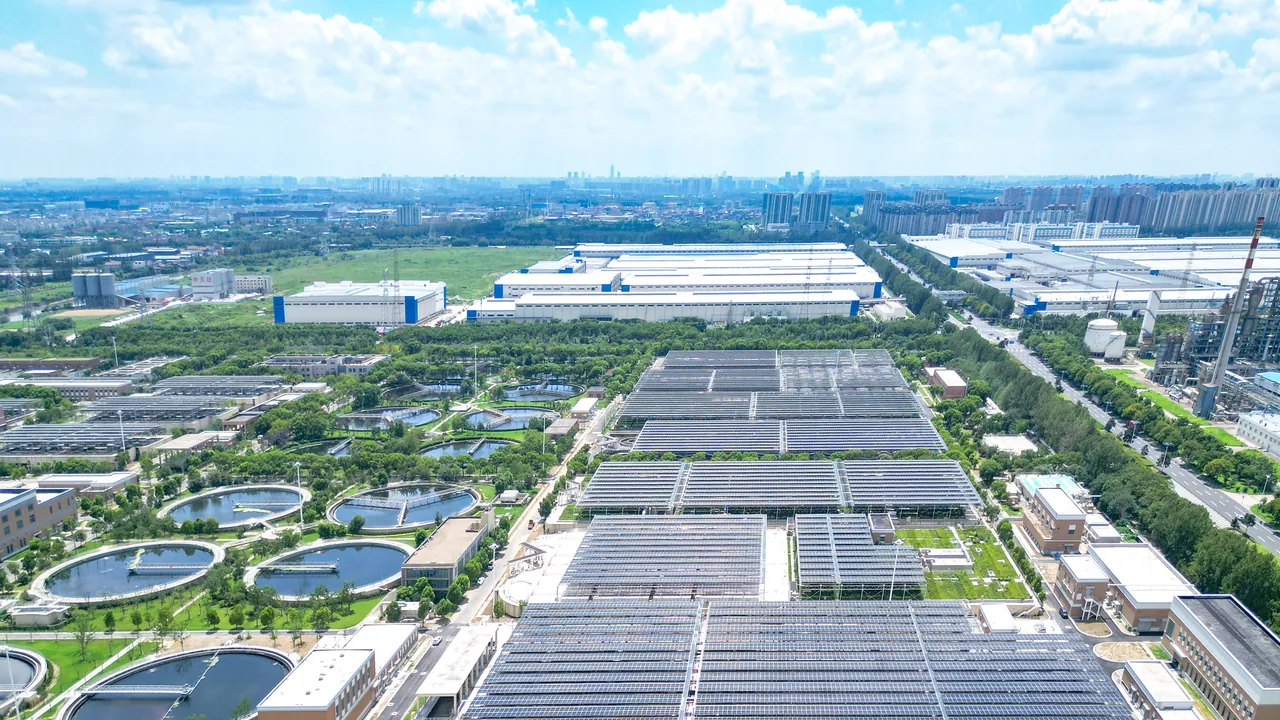
Some 95,000 m2 of PV panels cover the aeration tanks, with 15.7 MW installed capacity, an expected 16 million kWh per year and over 30,000 tCO2e avoided annually. During construction, 200,000 m3 of clean water needed for tank watertightness testing was replaced with reclaimed water, saving about 400,000 t of fresh water; more than 30% of construction waste was recycled. The project received a two-star green building certification.
Keeping the plant running throughout was the other challenge. CCTV inspection robots mapped the underground pipe network, cutting 108 planned pipe cut-overs to 45 with no shutdown and no drop in effluent quality. A 3.2 m diameter jacking pipe set a company record, seven underwater plugging operations were completed first time, and 30 confined-space entries recorded zero incidents.
Reported reclaimed-water output differs between sources - 40,000 m3/d in China Youth Daily's account, 30,000 m3/d in the contractor's release - so this case does not aggregate the two.
Sources: CPPCC News, "A low-carbon purification hub at the source of Taihu: Changzhou Jiangbian Phase V completed", 24 September 2026, https://www.rmzxw.com.cn/c/2026-09-24/3980988.shtml; China Youth Daily online, "Core project of Taihu governance passes completion acceptance", 24 September 2026, https://news.youth.cn/hotnews_41880/202609/t20260924_16886822.htm
Image: aerial view of the Phase V site, circular secondary clarifiers on the left with PV arrays on the tank roofs (source: CPPCC News)
Technologies
- Modified AAO biological treatment
- Sludge-water separation
- Deep-bed filter
- Ozone disinfection
- UF + RO dual-membrane reclaimed water
- Sludge anaerobic digestion with combined heat and power (CHP)
- Photovoltaic power generation on tank roofs
- Intelligent aeration control
Oct 26, 2026