
OtherMembrane Water Treatment Complete Systems (UF/NF/RO/EDI/CIP/Integrated)
Mengsu Zero-Carbon Park Industrial Wastewater Reclamation Plant, Ordos (100,000 m³/d)
Project Info
- Treatment Capacity
- 100,000 m³/d (of which 60,000 m³/d serves LONGi Photovoltaics and 40,000 m³/d serves other enterpris
- Location
- China Inner Mongolia Ordos Zero-Carbon Industrial Park, Mengsu Economic Development Zone, Ejin Horo Banner
About
The Mengsu Economic Development Zone industrial wastewater plant, also known as the water reclamation plant, sits inside the zero-carbon industrial park in Ejin Horo Banner, Ordos, Inner Mongolia. It was commissioned in October 2024 with a capacity of 100,000 m³/d and is described in Chinese state media as the country's first zero-discharge facility built specifically for photovoltaic (PV) manufacturing wastewater. It is operated by Ejin Horo Banner Pengyuan Water Supply Co., Ltd., with China Railway Shanghai Engineering Group as turnkey contractor.
Background
PV plants in the park generate large volumes of wastewater from wafer cutting, degumming and cleaning. The stream is high in silica, hardness, total dissolved solids and chloride, has an extremely low C/N ratio, and carries refractory organics and fluoride, so no single process can deliver both reuse-grade water and zero liquid discharge. Of the 100,000 m³/d capacity, 60,000 m³/d is dedicated to LONGi PV Technology and 40,000 m³/d serves other park enterprises. The plant comprises 41 structures and buildings plus 31 km of off-site pipelines.
Process train
The flowsheet runs in four stages. Pre-treatment combines equalisation, silica removal and hardness removal by high-rate clarification to protect the downstream membranes. Biological treatment uses a multi-mode AO system for organics and nitrogen. Advanced treatment links fluoride removal by high-rate clarification, ozonation plus MBBR, and a UF/RO double-membrane system; the permeate meets industrial reuse standards and is piped back to the park. RO concentrate enters the salt-separation train: silica and hardness removal, ion exchange, RO and nanofiltration fractionation, followed by separate sodium chloride, sodium sulphate and mother-liquor crystallisers. The operator says close to 30 process combinations are integrated in total.
Performance
During a February 2025 site visit by Economic Information Daily, the plant reported a 95% water recycling rate for PV wastewater, with the remaining concentrate crystallised into sodium chloride and sodium sulphate, achieving zero liquid discharge. The combination of high-rate reuse and fractional salt recovery was reported as the first of its kind for PV wastewater in China.
Not disclosed
Total investment, site area, exact construction and completion dates, and design influent/effluent parameters for individual units have not been published; no estimates are made here.
Sources
1. People's Daily Online / Science China: “The regeneration path of photovoltaic wastewater”, 11 November 2025, https://kpzg.people.com.cn/n1/2025/1111/c404214-40601289.html
2. Economic Information Daily (Xinhua Finance): “Wastewater is not waste, green power is greener — inside China's first PV wastewater zero-discharge project”, 13 February 2025, https://finance.sina.com.cn/money/bond/2025-02-13/doc-inekhueq8676850.shtml
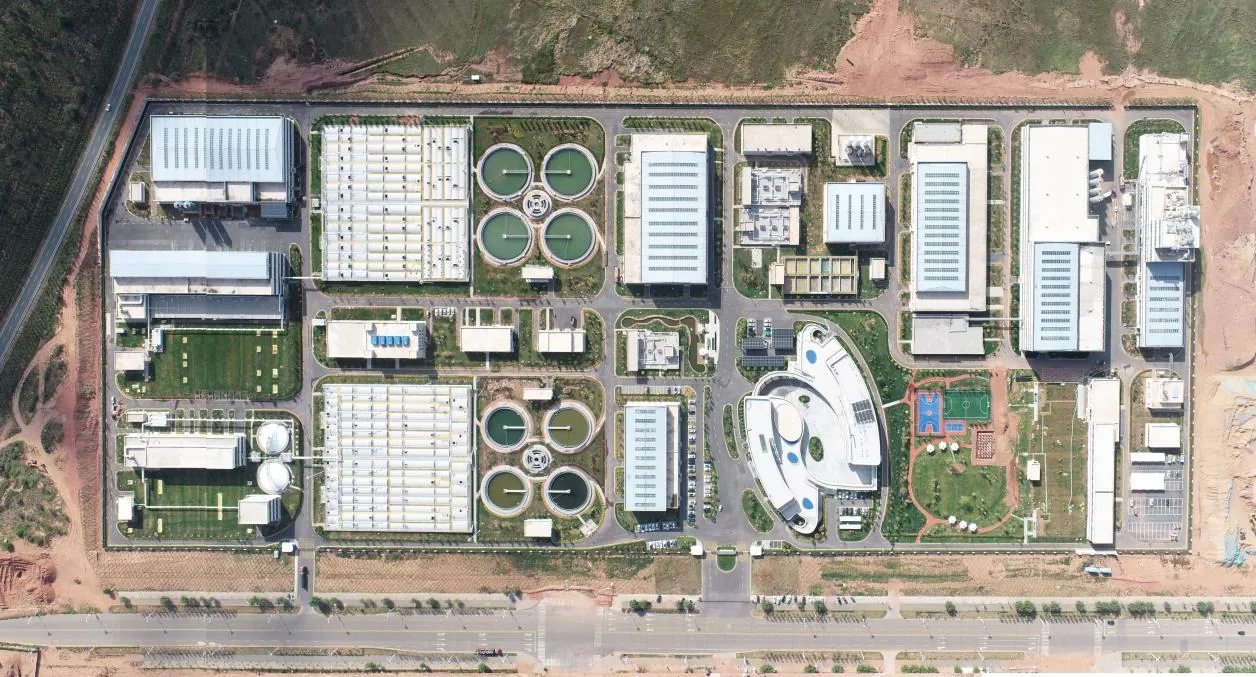
Image: aerial view of the plant, rows of rectangular biological basins on the left, four circular clarifiers in the centre, membrane workshop and ancillary buildings on the right (operating state after the October 2024 commissioning; image source: People's Daily Online / Science China, provided by the company)
Technologies
- High-efficiency silica and hardness removal by sedimentation
- Multi-mode AO biological treatment
- High-efficiency fluoride removal by sedimentation
- Ozone-based advanced oxidation + MBBR
- UF + RO dual-membrane process
- Nanofiltration salt separation
- Sodium chloride/sodium sulfate evaporation and crystallization salt separation
Oct 24, 2026