
OtherMBR Membrane Bioreactors (with Membrane Modules)
Qingdao Electronic Information Industrial Park Wastewater Treatment Plant (53,000 m³/d)
Project Info
- Treatment Capacity
- 5.3 万 m³/d(一期 2.2 万 + 二期 3.1 万)
- Location
- 中国 山东 青岛 青岛自贸片区中德生态园牧马山路
About
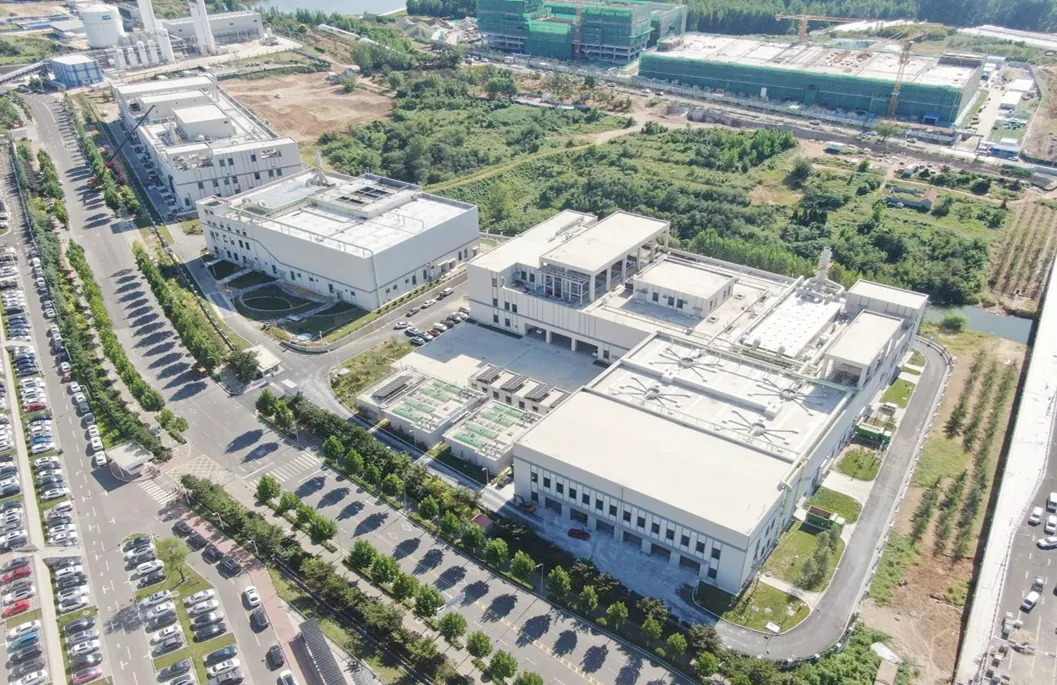
The Qingdao Electronic Information Industrial Park wastewater treatment plant stands on Muma Shan Road in the Sino-German Ecopark, part of the Qingdao free trade zone. It covers about 38,000 m² with 47,000 m² of built floor area and is designed for 53,000 m³/d — the largest single dedicated electronic-industry wastewater plant in China. It was developed by Sino-German United Group, with Dazhong Daily reporting Xihai'an Public Utilities Group as contractor. Phase I, at 22,000 m³/d, was completed and put into water in August 2023; Phase II followed in October 2024, bringing total capacity to 53,000 m³/d.
Background
Xihai'an New Area's chip and display cluster has grown quickly, and the wastewater from chip fabrication and electronic components is far more complex than municipal sewage, carrying fluoride and heavy metals. The existing Longquan River plant is a municipal facility without industrial treatment trains, so its capacity could not meet the park's needs. Construction began in 2023 on underground chemical storage, hydrolysis-acidification tanks, biological tanks and MBR cells, with design targets for both capacity and effluent quality.
Process
The plant runs a four-stage train: fluoride removal pre-treatment, biological treatment, MBR membrane treatment and advanced polishing. Fluoride- and metal-bearing streams are pre-treated first so they do not inhibit the biology downstream; the flow then passes through hydrolysis-acidification and biological tanks for biodegradability improvement, organics and ammonia removal; MBR cells handle solids separation at high mixed-liquor concentration with a small footprint; final polishing brings effluent to the quasi-Class IV direct-discharge standard, well ahead of ordinary industrial requirements. For electronics wastewater the difficulty is the overlap of fluoride, metals and organics, and this staged, stream-specific combination is built around exactly that.
Performance
By October 2025 the plant had treated 11.63 million m³, averaging about 23,000 m³/d, Dazhong Daily reported in December 2025. Total capacity of 53,000 m³/d equals the volume of 21 standard swimming pools and reaches 130% of the park's long-term projected wastewater flow — capacity deliberately built ahead of demand. It was the first urban-renewal environmental project completed in the Qingdao free trade zone in 2024.
Siting and delivery model
The site sits next to the park's core production area for easy collection, while avoiding residential zones to limit nuisance. Construction followed a "plan and build environmental infrastructure in step with industry" approach with phased, rolling commissioning: Phase I solved the immediate need as companies moved in, and Phase II was added as the cluster grew.
Not disclosed
Total investment, the split between phases, construction and completion dates, design influent and effluent parameters beyond the quasi-Class IV standard, and sludge disposal routes are not published and are not estimated.
Sources
1. Dazhong Daily, "What a wastewater plant says about industry-city win-win", 11 December 2025, https://dzrb.dzng.com/general/0/NEWS2962276HDKWBBNATEKGB
2. China Construction News, "Green infrastructure powers Qingdao's chip and display industry", 10 December 2025, http://www.chinajsb.cn/html/202512/10/53463.html
Image: aerial view of the plant, with biological and MBR basins arranged on the roofs of the white box-type buildings (operating, December 2025; source: Dazhong Daily).
Technologies
- 除氟预处理
- 水解酸化
- 生化处理
- MBR 膜生物反应器
- 深度处理
- 准Ⅳ类直排标准
Oct 25, 2026