
ChemicalMembrane Water Treatment Complete Systems (UF/NF/RO/EDI/CIP/Integrated)
Wanhua (Penglai) Seawater Desalination Project, Phase I (100,000 m³/d)
Company: Wanhua Chemical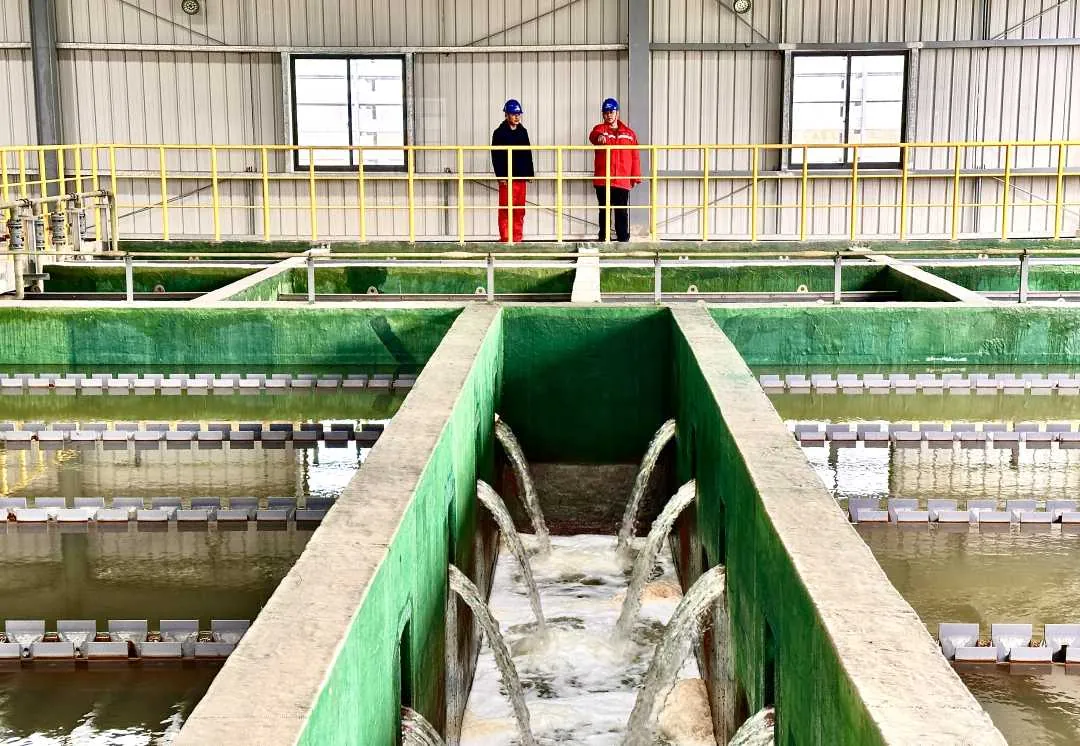
Project Info
- Treatment Capacity
- 10 万 m³/d(一期)
- Investment
- 18 亿元(三期合计)
- Location
- 中国 山东 烟台 蓬莱区万华(蓬莱)新材料低碳产业园
- Completion
- Apr 28, 2025
About
Wanhua's Penglai seawater desalination plant sits in the Wanhua (Penglai) new materials low-carbon industrial park in Penglai, Yantai, Shandong. Jointly financed by Chinese and French partners with a total investment of CNY 1.8 billion, the scheme is built in three phases of 100,000 m³/d each. Phase I was commissioned on 28 April 2025 with 100,000 m³/d of capacity, making it the largest industrial membrane desalination project planned in China and the country's first to be fed by power-plant cooling water.
Background
The park lies in a water-scarce corner of the Jiaodong Peninsula while its chemical plants keep growing. Rather than drawing from the sea, the plant takes the cooling return flow of a nearby power station — water at 8–38 °C year round. Conventional desalination needs extra heating or accepts lower output in winter; using this waste heat removes that penalty and also avoids a dedicated intake structure and its effect on the marine environment.
Process
The plant is a pure physical reverse-osmosis system. Seawater passes through coagulation-sedimentation and mechanical (multi-media) filtration to strip suspended solids and colloids, then is pressurised into a two-stage RO train that rejects dissolved solids, contaminants and heavy metals; the permeate feeds the park's production water network. Energy-recovery devices convert the pressure of the high-pressure brine stream back into useful power. A cascaded, or "series-stage", layout removes intermediate tanks and lift pumps between core process units, cutting footprint, capex and operating cost. The project team puts the operating-cost saving at more than 15% against a conventional dual-membrane train.
Performance
Economic Daily reports phase I output of up to 100,000 m³/d, replacing more than 36 million m³ of surface water a year; once all three phases are complete the plant will supply 108 million m³ annually. Phase I runs as an unattended "dark factory" — the whole plant operates with screens off — a notable departure from conventional desalination plants. For the park, the reliable high-quality industrial water replaces surface abstraction and forms part of its zero-carbon chemical cluster; for the region, desalination that neither competes with inland users nor depends on rainfall offers a scalable route to industrial water security.
Capacity note
Mainstream reporting (CCTV News, Science and Technology Daily, Economic Daily, Guangming Daily) gives Phase I as 100,000 m³/d. A Yantai municipal press conference in April 2026 referred to "50,000 m³/d of Phase I" commissioned, which likely reflects a staged start-up; the two figures are not combined here.
Not disclosed
Construction start dates per phase, the investment split between phases, unit water cost, RO recovery and feed seawater quality are not published and are not estimated.
Sources
1. Economic Daily, "China's largest industrial membrane desalination project commissioned", 15 March 2025, https://www.jingjiribao.cn/static/detail.jsp?id=575752
2. Science and Technology Daily, "China's first desalination project using power plant cooling water goes into operation", 28 April 2025, https://www.stdaily.com/web/gdxw/2025-04/28/content_332583.html
3. Yantai Municipal Government Information Office, press conference transcript, 17 April 2026, https://ytfb.shm.com.cn/2026-04/17/content_5483452.htm
Image: seawater passing through the coagulation-sedimentation basins ahead of pre-treatment at the Penglai plant (operating, 15 March 2025; source: Economic Daily, photo by Xie Zhihua and Li Lun).
Technologies
- 絮凝沉淀预处理
- 多介质过滤
- 两级反渗透(RO)
- 能量回收装置
- 串级工艺
- 全流程无人值守控制
Oct 25, 2026