
OtherZero Liquid Discharge Complete System
Zhongmei Jingyuan Power Plant FGD Wastewater Zero-Liquid-Discharge Retrofit for Units 7 and 8, Baiyin (15 m³/h; low-temperature flash evaporation plus flue-gas drying)
Project Info
- Treatment Capacity
- 15 m³/h (desulfurization wastewater treatment capacity), producing 8–10 m³/h of reclaimed water
- Location
- China Gansu Baiyin Pingchuan District, Baiyin City; plant premises of China Coal Jingyuan Power Generation Co., Ltd., desulfurization wastewater treatment workshop for Units 7 and 8
About
Zhongmei Jingyuan Power Generation Co., Ltd. operates on the upper reaches of the Yellow River in Pingchuan District, Baiyin, Gansu. Its flue-gas-desulfurization (FGD) wastewater zero-liquid-discharge retrofit for Units 7 and 8 has passed a 168-hour full-load trial run and moved into routine operation, with all FGD wastewater reused on site and none discharged.
Wet FGD effluent carries high salt loads, heavy metals and suspended solids. Conventional neutralization and sedimentation only meets discharge limits and cannot be reused, while high-salinity discharge pressures the river basin. Rather than building a standalone evaporator train, the plant turns its own waste heat and flue gas into treatment resources, combining low-temperature flash evaporation with flue-gas drying: the wastewater is boiled at 60-70 °C under vacuum using recovered waste heat from power generation; the vapour is condensed into clean distillate and returned to the process; the residual brine, highly saline and corrosive, is evaporated to dryness in the flue-gas drying stage, and the salt is collected in a closed loop with no secondary wastewater.
The unit occupies only 0.576 mu (about 384 m²), treats 15 m³/h of FGD wastewater and yields 8-10 m³/h of reclaimed water. Since commissioning, much of the plant's landscaping and dust-suppression demand is met with recycled process water. The retrofit converts end-of-pipe treatment into a system loop: no FGD wastewater leaves the site, fresh water intake falls, and waste heat and flue gas that were previously vented are used on site, creating cascading use of wastewater, heat and solid residue. For coal-fired plants along the Yellow River, the route avoids large new footprints and high-grade steam, offering a replicable option for comparable units.
Sources: Baiyin Municipal People's Government, 'A green duet of water and fire: Zhongmei Jingyuan Power achieves zero discharge of FGD wastewater', 9 July 2026, originally published by New Gansu - Gansu Economic Daily, https://www.baiyin.gov.cn/zjby/bygl/bygy/art/2026/art_3d6b382a297a4b7baf6192bfe5be6427.html.
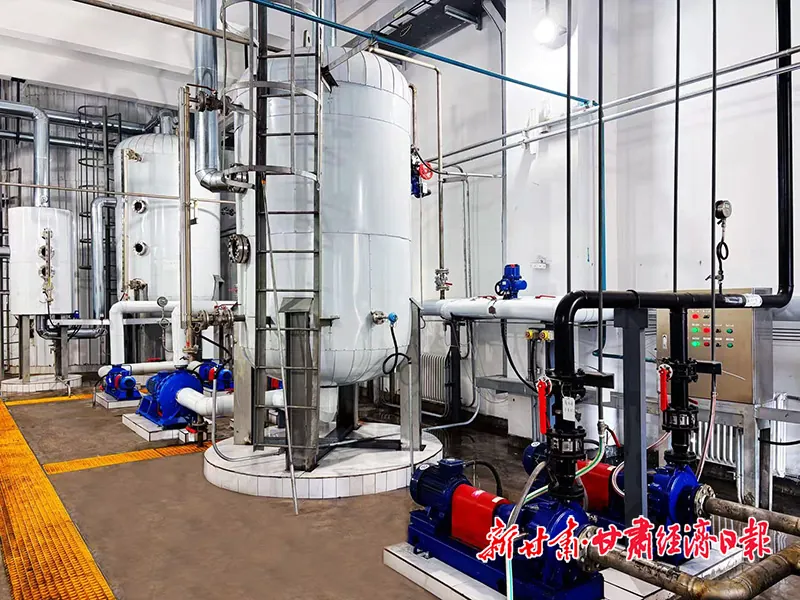
Image: interior of the FGD wastewater zero-discharge workshop for Units 7 and 8, showing the low-temperature flash evaporators, pumps and dosing lines in operation after the retrofit (source: New Gansu - Gansu Economic Daily, republished by Baiyin Municipal Government).
Technologies
- Vacuum low-temperature flash evaporation concentration (60–70 °C)
- Recovery and utilization of waste heat from power generation
- Salt crystallization via high-temperature flue gas drying
- Reuse of distilled water in production processes
- Closed-loop collection and disposal of salt residue
- On-site reclaimed water used for greening and dust suppression
Oct 29, 2026