Textile & DyeingOzone Catalytic Oxidation Equipment (incl. Ozone-Hydrogen Peroxide Synergy)
Shaoxing Keqiao Jiangbin Centralised Dyeing Wastewater Treatment Plant (serving 66 dyehouses; 820,000 m³/d district system)
Project Info
- Treatment Capacity
- 820,000 m³/d (Keqiao district-wide printing and dyeing wastewater system)
- Location
- China Zhejiang Shaoxing Binhai Industrial Park, Keqiao District, at the plant of Shaoxing Keqiao Jiangbin Water Treatment Co., Ltd.
About
Keqiao District in Shaoxing is known as a city built on fabric: it accounts for 40% of China's dyeing and printing capacity and 60% of Zhejiang's. Dyeing is water-intensive - industry estimates put 3 to 5 tonnes of water behind every 100 metres of fabric - and the effluent carries dyes, sizing agents and auxiliaries that make it dark, saline and hard to biodegrade, a long-standing pressure point for the Qiantang River basin.
Background
In 2010 the district introduced a consolidation policy with four entry thresholds - scale, equipment, energy and emissions - and moved 114 dyehouses into the Binhai industrial park. Closures, mergers and restructuring left 57, and water supply, power and centralised wastewater treatment were built alongside. Shaoxing Keqiao Jiangbin Water Treatment Co. was created for that purpose. Today 110 dyehouses sit in the park, split into 66 in the clustered zone and 44 in the upgrading zone, served by two plants; Jiangbin handles the clustered zone and treats dyeing effluent only.
Process
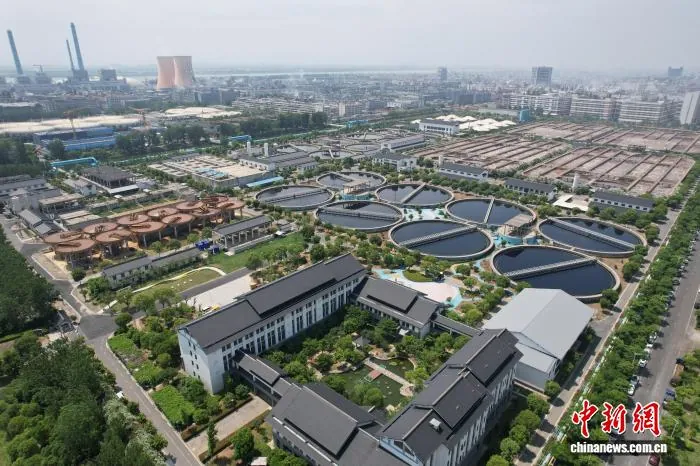
A dedicated collection network pipes effluent from the 66 neighbouring dyehouses straight into the plant, so it is never diluted by other sewage. Treatment runs through physicochemical, biological and advanced stages: coagulation removes colloids and part of the colour, activated sludge degrades organics, and the advanced stage targets colour and recalcitrant COD. As Zhejiang revises its textile discharge standard with possibly tighter total-load limits, Keqiao has invested RMB 1.11 billion in process upgrades and digital retrofits at both plants, introducing three-phase catalytic oxidation to cut COD and total nitrogen loads.
Digital operations
Keqiao now runs a professional dyeing-wastewater system of 820,000 m3/d, treating more than 170 million tonnes a year. Since 2025 Jiangbin has been building a closed-loop intelligent system: on the hardware side, automated national-standard laboratory robots, activated-sludge sensors, inspection robots and drones form an air-ground-water sensing network; on the software side, a water utility large model ingests and cleans more than 12,000 data sources a day and drives agents for carbon dosing, sludge wasting, diagnosis and process decisions. Automated sampling and analysis cut a water test to two hours, and robot inspection with image recognition lifted defect detection accuracy from 65% to 95%, turning two-hour post-failure response into early warning. The system is due to complete commissioning by the end of September 2026.
Why it matters
Centralised treatment spares individual mills the cost and land of their own plants while coping with complex, high-activity effluent, and Keqiao's operating data has fed into the national standard revision for the textile sector.
Sources: China News Service, "Keqiao, Zhejiang: How Is Wastewater Treated Behind a Piece of Cloth?", 6 March 2026, https://www.chinanews.com.cn/sh/2026/03-06/10582351.shtml
Image: aerial view of the Jiangbin plant, banks of circular clarifiers and biological tanks beside the Cao'e River (Source: China News Service, photo by Shaoxing Keqiao Water Group)
Technologies
- Dedicated collection pipe network for printing and dyeing wastewater
- Physicochemical pretreatment
- Biochemical treatment
- Advanced treatment
- Three-phase catalytic oxidation
- Intelligent control based on a water utility large model
- Intelligent inspection robots and drone inspection
- Online automatic water quality monitoring
Oct 27, 2026